

You’ve heard it thousands of times. That satisfying click every time you snap a photo on your iPhone. What most people don’t know is that sound has a very specific origin — and it predates the smartphone by three decades.
A brief history
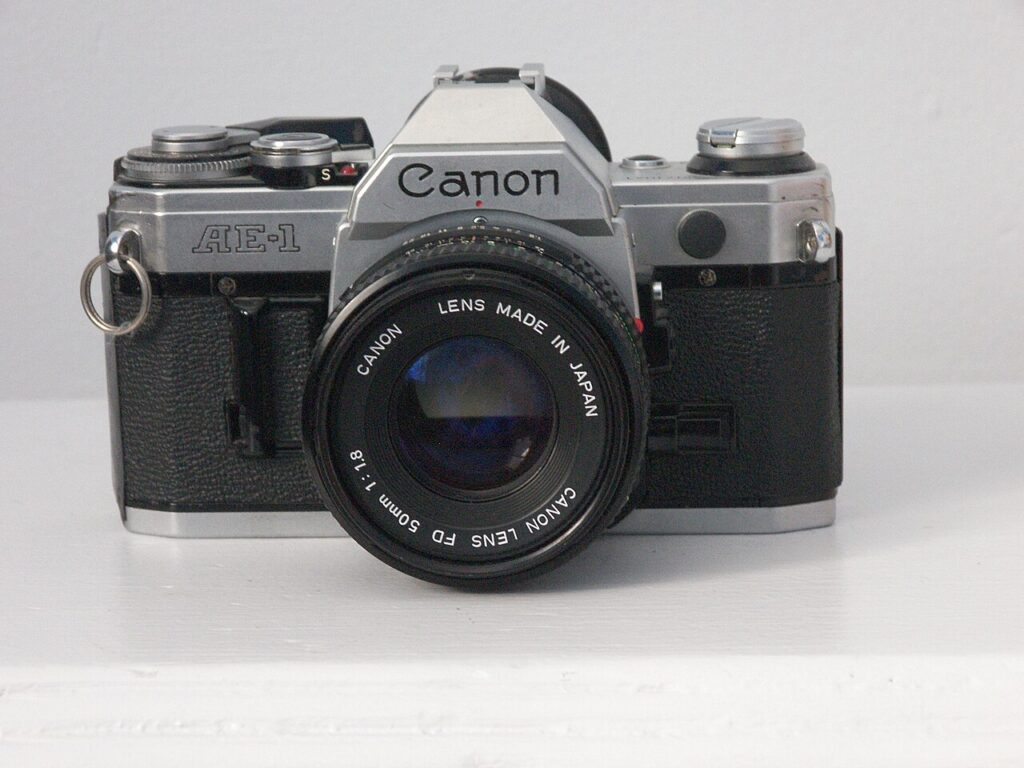
Terri Monahan from Wellington, FL, USA, CC BY-SA 2.0 via Wikimedia Commons
Canon introduced the AE-1 in 1976 at a time when serious photography was largely out of reach for the average person. Cameras required manual adjustments for every shot — aperture, shutter speed, focus — knowledge that took years to develop. Canon changed that with the AE-1’s automatic exposure system, letting the camera handle the technical heavy lifting while the photographer focused on the shot.
It was also the first camera to use a microprocessor, a decision that kept manufacturing costs low enough to price it accessibly. Canon backed it with an aggressive advertising campaign — unusual for the camera industry at the time — even sponsoring the 1980 Winter Olympics. It sold over one million units in its first three years in the US alone.
The result: a generation of people who grew up with a Canon AE-1 in their hands. The distinctive shutter sound became the sound of capturing a moment and it was embedded in the cultural memory of photography itself.
Apple’s involvement
When Apple introduced the camera feature on the original iPhone in 2007, they faced an interesting design question: what should it sound like? Rather than invent something new, they looked to the most iconic camera sound in living memory — the Canon AE-1.
The man behind the sound was Jim Reekes, a sound designer and senior software architect at Apple from 1988 to 1999. Reekes worked on QuickTime, macOS, and hardware during his time there, and is best known for his contributions to Apple’s audio identity — including the famous Mac startup sound and the Sosumi beep. He recorded the shutter sound from a Canon AE-1 he’d owned since high school, originally for the macOS screenshot function. When Apple built the iPhone camera in 2007, they didn’t need to look far — the perfect sound was already sitting in their library.
What makes it even better is that the AE-1 Reekes used was unserviced, meaning the characteristic whine in the recording is actually the sound of ageing internal parts — something Canon owners know as “Canon Squeal.” Every time someone takes a photo on an iPhone, they’re hearing a slightly broken camera from the 1970s. “Any time you take a photo with the iPhone it’s my camera,” Reekes has said. “Even to this day when I hear people take photos with their iPhone I look to see who stole my camera.”
Why that sound?
The choice was deliberate. Apple’s design philosophy has always centered on feel as much as function, and that mechanical shutter click carried decades of emotional weight. It was the sound of photography. By borrowing it, Apple gave the iPhone camera an instant sense of legitimacy and familiarity in a single click.
Today that sound has been heard more times than any physical camera shutter in history. Every photo taken on an iPhone — billions per day — plays a digital recreation of a 1970s film camera. Most people never question it. They don’t need to. It just sounds right.
Why it still matters today
Film photography was supposed to be dead. Digital cameras killed it in the 2000s, and smartphones finished the job. For a while it seemed like 35mm film would fade into the same obscurity as VHS tapes and floppy disks.
However, over the past decade, film photography has had one of the most unlikely comebacks in consumer technology history. Kodak restarted its production lines, film prices surged, and sitting at the center of it all, once again, is the Canon AE-1 — the camera that started it all.
Used AE-1s that were being given away at garage sales fifteen years ago now regularly sell for $150 to $200 on eBay. A camera that was designed to be affordable in 1976 has become a coveted object in 2026, sought after by photographers who weren’t born when it was discontinued.
There’s also an irony worth noting here. Apple borrowed the AE-1’s sound to make the iPhone feel authentic. Now a generation raised on iPhones is buying AE-1s to feel something the iPhone can’t replicate — the weight of a mechanical camera, the commitment of a finite roll of film, and yes, that shutter click. The real one.